Comic book grading glossary
Short definitions for the words that actually move a raw grade — so a listing and a photo mean the same thing.
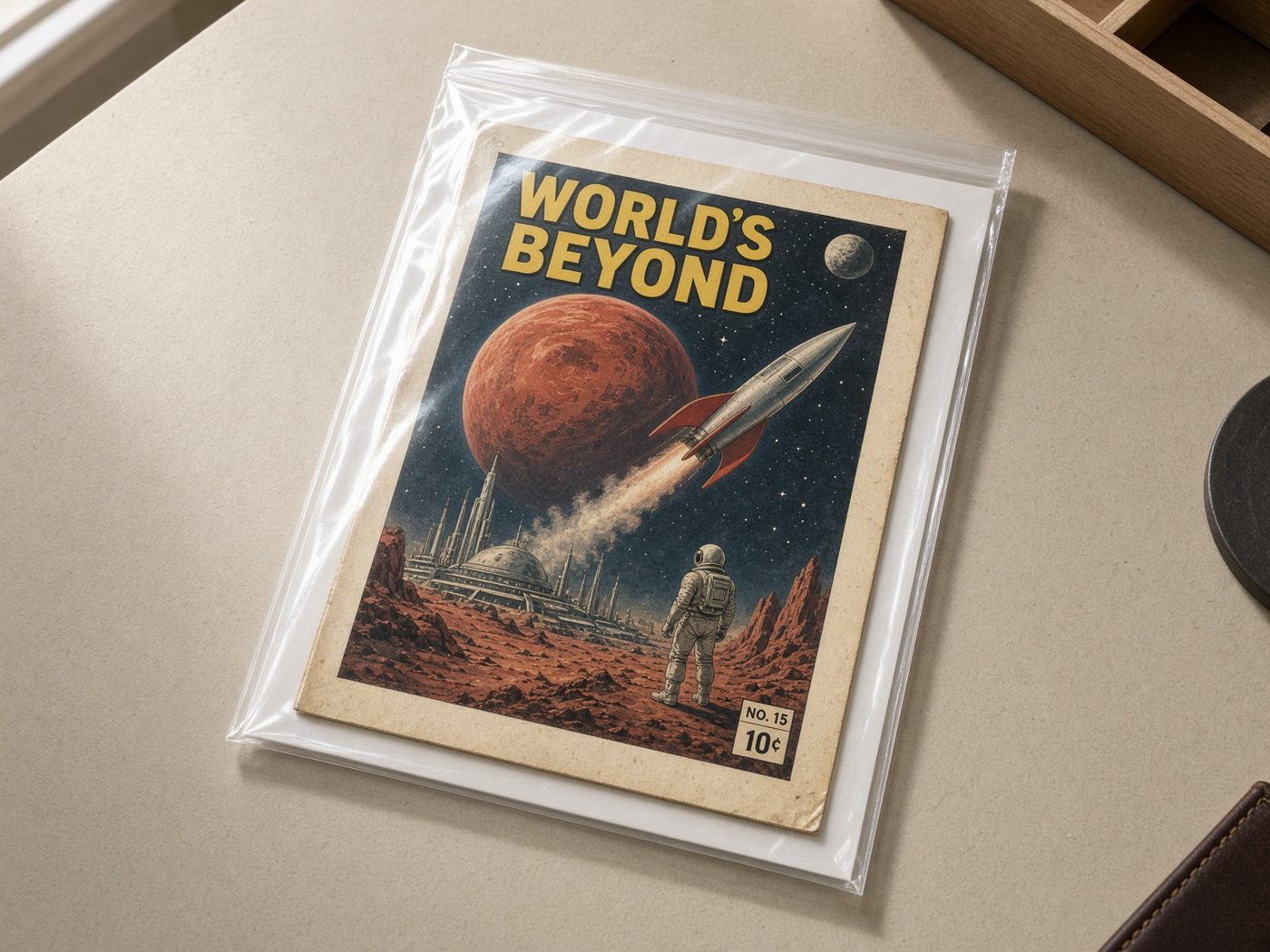
The copy in hand
Raw means unrestored and unencapsulated: you can still open the book. A raw grade is a condition estimate of that copy from photos, not a sealed certificate and not a price. Restoration (color touch, pieces added, cleaned in a way that alters paper) is disclosed separately; this site grades apparent raw condition and will note obvious repairs when they are visible.
| Term | Meaning |
|---|---|
| Raw | Unrestored, unslabbed book in hand. Still a book. |
| Slab | A sealed holder. A different service. This site does not slab or predict a holder grade. |
| Designation | The name next to the number: Gem Mint, NM, VF, FN, VG, GD, FR, Poor. |
| Conservative | When the book sits between two rungs, assign the lower one. |
| Completeness | All story pages and covers present. Missing paper outweighs gloss. |
Defects that move the number
Collectors reuse “crease,” “wear,” and “ding” for defects that do not cost the same. Use the more precise word when you can. Length is only one factor; color break, depth, location, and accumulation all matter.
| Term | Meaning |
|---|---|
| Color break | Ink cracked; paper shows through, usually a white line. More serious than the same defect without a break. |
| Non-color-breaking | The cover is stressed or bent but the ink film is intact. |
| Spine tick | Short stress at the spine, often from stacking. Color-breaking ticks cost more. |
| Spine stress | Compressed line from reading or boxing. Intact ink is milder than a tick. |
| Spine roll | Curve away from a flat, square spine. Not the same as a split. |
| Spine split | Separation along the spine fold. A structural break. Allowances grow as the grade falls. |
| Chip | Missing paper. Not a soft blunt corner. |
| Tear | A split with both sides of the paper still present. A flap that lifts is on the way to detachment. |
| Blunt / ding | Corner or edge rounded without missing paper. Handling wear. |
| Right-edge wear | Riffling or box wear along the open edge. Accumulation of small hits adds up. |
| Manufacturing | Printer crease, miswrap, bindery chip. More lenient than handling except at 9.8+. |
| Handling | Wear from reading, stacking, bagging, or showing the book. |
Paper, letters, and the scale
Page quality is judged on an interior spread in even light, not a white-balanced cover. Letter grades are bands; this site reports a number. Only the listed decimals are valid — there is no 9.7, 9.5, or 8.8 here.
| Term | Meaning |
|---|---|
| White | Required for 10.0. Uncommon on older newsprint. |
| Off-White | Typical minimum for 9.8+. Off-White to White is the floor for 9.9. |
| Cream | Honest interiors for nice books that are not the top of the ladder. |
| Light tan / tan | Warm paper. Light Tan to Off-White max 8.5. Tan to Off-White max ~7.5. |
| Slightly brittle | Stiff, losing suppleness. Cannot exceed 6.5. |
| Brittle | Chips, flakes, or cracks when turned. Cannot exceed 3.5. Do not force the book open. |
| NM | Near Mint band, roughly 9.2–9.8 (9.0 sometimes). Not a single number. |
| VF | Very Fine band, roughly 7.5–9.0. Classic VF: small non-color-breaking crease. |
| FN | Fine band, roughly 5.5–7.0. A major defect or heavy accumulation. |
| VG | Very Good band, roughly 3.5–5.0. Average collectible. |
| Press | Humidity and weight to relax waves, light roll, some non-breaking bends. Cannot restore ink, chips, splits, or brittleness. |
How to use this glossary
If a listing uses a vague word, translate it. “Wear” might be a blunt corner or a color-breaking tick. “Crease” might break color or not. Photograph the defect in raking light and read it against the 10-point scale. For a walkthrough, start with how to grade a comic book at home. For the full ladder, open the grading scale. For NM vs VF vs FN, use the letter-grade guide.
Chart estimate for raw condition only — not a professional certification.
Grade a book